Viability-Guided Sim-to-Real Transfer for a Small Fixed-Wing Glider in Uncertain Indoor Updrafts
Abstract
Motivated by low-altitude flight near terrain, structures, or other flow-shaping boundaries, where local lift can extend endurance but can also remove recovery margin when encountered from an unfavourable state, this thesis investigates whether a small fixed-wing glider controller developed in simulation can transfer to repeated real flights through uncertain local updrafts. To study this problem repeatably, the thesis develops an indoor fixed-wing sim-to-real workflow in Imperial College London's Brahmal Vasudevan Multi Terrain Aerial Robotics Arena, combining Vicon motion capture state feedback, a measured command path and latency model, a manufactured glider, a safety-bounded flight volume, and fan-generated updrafts represented by measured but imperfect surrogates.
The controller is formulated as viability-guided manoeuvre primitive selection. Instead of tracking a long planned trajectory through an uncertain flow field, the glider repeatedly selects short stabilised manoeuvre primitives every 0.10 s in flight. Each primitive is generated, replayed, and validated offline so that online selection can use explicit evidence about entry compatibility, continuation probability, hard-failure risk, safety margin, lift exposure, and energy change. The resulting dense primitive library is then compressed into executable tiers, exposing the trade-off between manoeuvre coverage and computation speed.
Simulation results show that the approach is computationally practical and physically constrained by launch energy. The final mission simulations contain 36,000 runs and 384,795 executed 0.10 s primitive segments. For feasible launch speeds, approximately above 5.0 m/s, the balanced compressed library preserves mission performance of the raw dense library while reducing the mean evaluated set from 110.1 to 7.0 candidates and completing 85.2% of selector decisions within the primitive horizon.
Real flight testing confirms the main sim-to-real transfer claim under a more conservative practical launch speed range. The strongest evidence comes from random fan layouts that were not included in the held-out simulation validation during controller development: compared with open-loop flight, closed-loop success increases from 30.0% to 86.7% in the random three-fan layout and from 20.0% to 93.3% in the random four-fan layout. The thesis therefore demonstrates sim-to-real transfer not as one successful trajectory, but as a traceable evidence chain from modelling and validation to repeated real flight survival through uncertain indoor lift.
Links
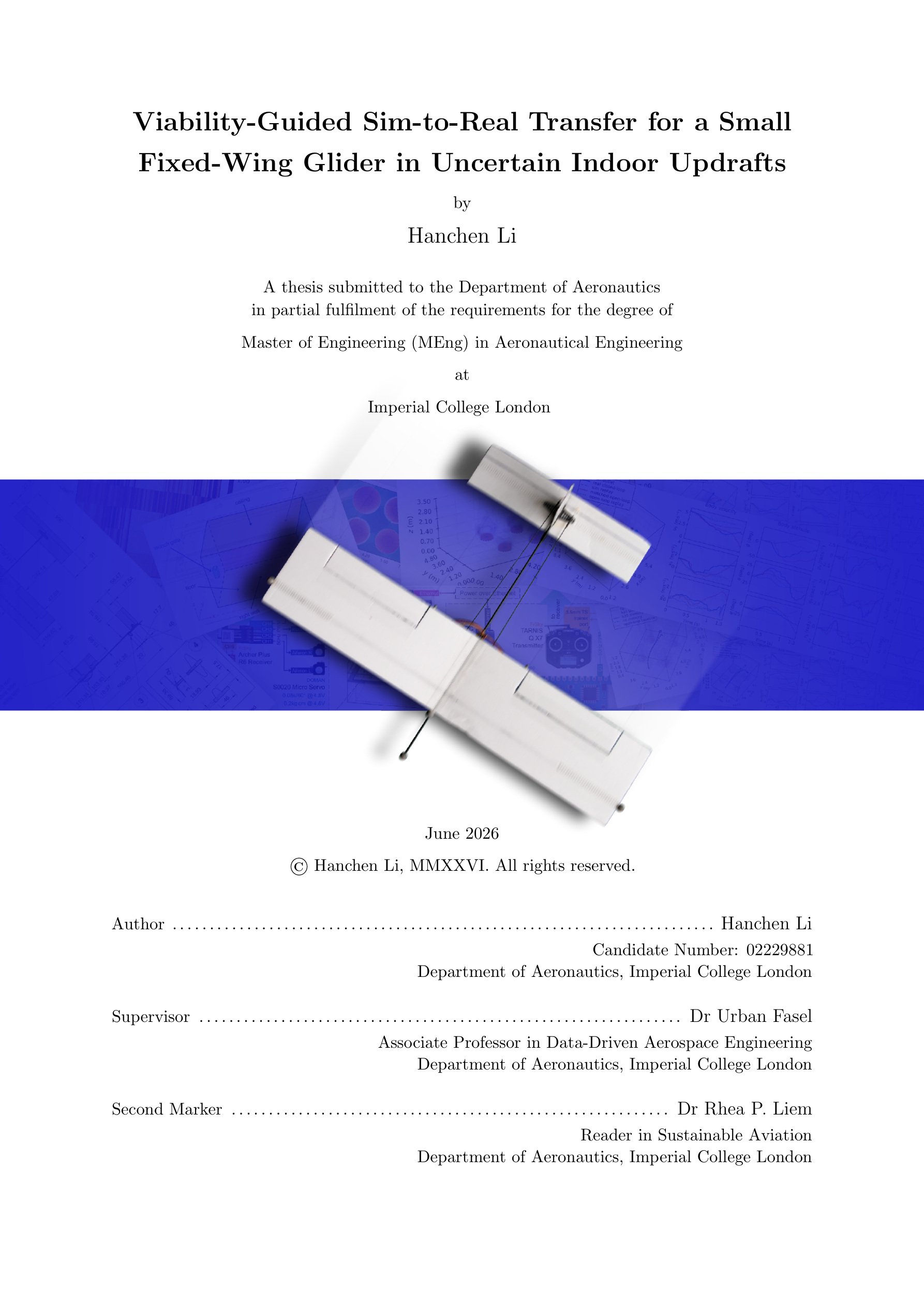
- Full-quality thesis PDF (49.319 MB)
- Google Scholar compatible PDF (4.999 MB)
- Thesis DOI: https://doi.org/10.5281/zenodo.21083555
- Project materials DOI: https://doi.org/10.5281/zenodo.20927007
- Workflow repository: https://github.com/GH-X-ST/Nausicaa
- Thesis repository: https://github.com/GH-X-ST/Nausicaa-Thesis
Citation
For academic citation, please cite the MEng thesis:
@mastersthesis{li2026nausicaa_thesis,
  title  = {Viability-Guided Sim-to-Real Transfer for a Small Fixed-Wing Glider in Uncertain Indoor Updrafts},
  author = {Li, Hanchen},
  school = {Imperial College London},
  year   = {2026},
  type   = {MEng thesis},
  note   = {Department of Aeronautics},
  doi    = {10.5281/zenodo.21083555},
  url    = {https://doi.org/10.5281/zenodo.21083555}
}
For the archived software, datasets, logs, and reproducibility materials, cite the project-materials record:
@misc{li2026nausicaa_materials,
  title     = {Nausicaa: Project Materials for Viability-Guided Sim-to-Real Transfer for a Small Fixed-Wing Glider in Uncertain Indoor Updrafts},
  author    = {Li, Hanchen},
  year      = {2026},
  publisher = {Zenodo},
  version   = {v2026.06-thesis},
  doi       = {10.5281/zenodo.20927007},
  url       = {https://doi.org/10.5281/zenodo.20927007}
}